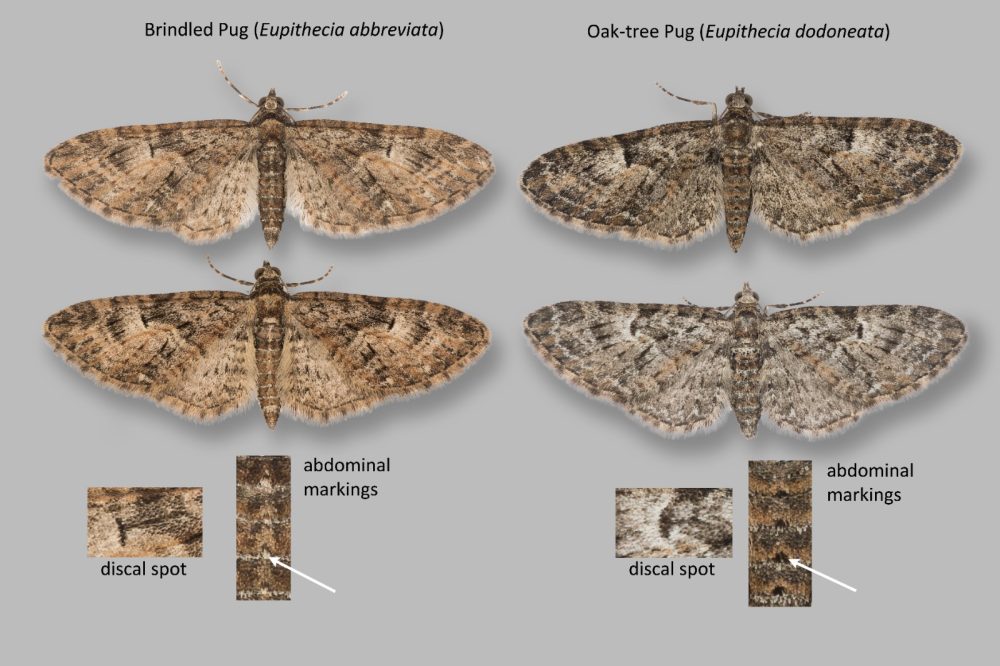
Identification Guidance for Oak-tree Pug v Brindled Pug by Christian Heintzen.
Here is a quick panel made from my own photographs to illustrate some of the differences between Oak-tree Pug and Brindled Pug.
The key differences are well documented in various printed and online sources but I thought, aside from other distinguishing features, there are a few things that are worth adding from my point of view.
- 1) Many of the photos submitted with records are of such poor quality that it is difficult, sometimes impossible, to ID species that are similar in appearance. Many are lacking in definition, focus and/or are taken in poor light or highly variable illumination, so colour rendition is often unreliable.
- 2) Given standardised lighting and in my experience, Brindled Pug has ‘warmer’ brown tones, whilst Oak-tree Pug is like a less saturated ‘greyer’ colour.
- 3) The discal spot is a fairly good diagnostic character. I find that the thin discal spot of Brindled Pug and the darkened portion of the proximal wing vein that attaches to it forms a neat ‘T” with a long base that lies on its side. The discal spot of Oak-tree Pug is much broader and often doesn’t have the proximal wing vein darkened or if so only for a much shorter distance, so either doesn’t form the ‘T” or if it does a “T’ with a very short base.
- 4) Perhaps the best way of quickly distinguishing them is by looking at the abdominal spots that border the distal edge of the tergites. In Brindled Pug they tend to be white whilst they are black in Oak-tree Pug. It may well be known but I haven’t seen this mentioned in the literature, so not sure if it always holds but in my specimens and what I have seen on the internet it seems to be consistent.
-
- What are Tergites? They are thickened armoured plates on the top side of the moth’s abdomen. Moths have a segmented abdomen, and each segment usually has one main tergite covering the top, while a sternite covers the bottom, and pleurites cover the sides.
-
-
-
- Function: They provide structural support and protection for the moth’s body.
-