

62.025 BF1454b
– Chequered Pine Knot-horn – Dioryctria sylvestrella – (Ratzeburg, 1840)
Adult Micro:
CAT 3
– Very rare or scarce species (includes very scarce adventives/immigrants) –
 Leaf-miner:
CAT A
– Recorded accepted without the leaf or a photo –
Larval Case:
C1
– Distinctive Species –
Leaf-miner:
CAT A
– Recorded accepted without the leaf or a photo –
Larval Case:
C1
– Distinctive Species –
 – click for General Verification Guidelines |
– click for Specific Verification Guidelines
– click for General Verification Guidelines |
– click for Specific Verification Guidelines
Leaf-miner:
CAT A
– Recorded accepted without the leaf or a photo –
Larval Case:
C1
– Distinctive Species –
– click for General Verification Guidelines |
– click for Specific Verification Guidelines
 – Significant Record / Rare / Vagrant
 – Migrant
** Photograph required
**
 – care required in the identification process, as confusion with similar species is likely – quality photographs required.
Confusion Species: Dioryctria abietella (Pine Knot-horn); Dioryctria schuetzeella (Spruce Knot-horn);Dioryctria simplicella(Drab Pine Knot-horn):
ID pointers: A smoothly curved sub-terminal line helps to distinguish this from other similar species, of which there are four Dioryctria species occurring in Britain and this is also generally the largest of the four.
Distribution:
DaNES records 4 prior to 2010 and one from Rosliston Forest Centre, Swadlincote 22/7/2016: One Belper 17/9/2024
General Comment: None
*** Last updated on 5 November 2025 by RP ***
Last Recorded Year: 2024
First Recorded Year: 2016
Last Recorded By – Dave Evans
Last Recorded General Area – Belper
Images of Interest

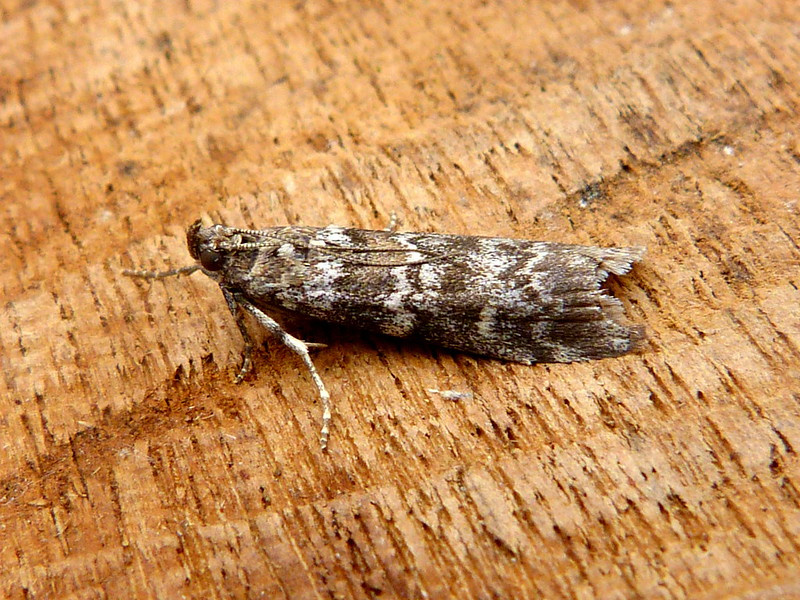
Image Gallery
No gallery images found for this moth.
Temporal Distribution Chart
Adults: (between 2016 - 2026)
(click legend below to show/hide datasets)
This chart summarises all available historical occurrence records collated by ISO week of the year. It reflects recorder effort and sampling distribution as well as true biological activity, and should be interpreted as an indicative pattern of seasonal occurrence rather than a statistically controlled abundance or phenology model.
Changes in First and Last Recorded Activity Dates Over Time
Activity Data Range:
2016 –
2026
Earliest Appearance:
22nd July (in 2016)
Latest Appearance:
29th September (in 2026)
This chart presents a time-series summary of recorded observations. It is based on available records at the time of analysis and will evolve as further data are added. The rolling mean provides a smoothed representation of variation in recorded activity over time. Annual record totals are shown for context; years with fewer records may provide a less complete representation of activity than years with higher recording intensity. Interpretation should consider that apparent trends may reflect both biological change and variation in recording effort.
Monthly Records By Year:
Dioryctria sylvestrella
( data includes both Larvae and Adult Stages )
Monthly Counts By Year:
Dioryctria sylvestrella
( data is based on 'Adult' stage records only )
First/Last Recorded Dates: Dioryctria sylvestrella
Adult-only & Anything [Larvae, Pupae, Adult, Mines]
Shading shows moth presence between dates
Click the colour discs below to Select/De-select as Required
Recordings By Year: Dioryctria sylvestrella
( All data includes both Larvae and Adult Stages )
Hectad (10kmx10km) Coverage: Dioryctria sylvestrella
( data includes both Larvae and Adult Stages )
Flight Periods – Indicative –vs– Recorded Data
Dioryctria sylvestrella
Dioryctria sylvestrella
Flight Period chart – the grey hatched area above, which can cross one or more months, pictorially represents the best guess we have for this moth's flight periods [month/s]. The coloured lines represent the actual months seen in flight, from site observation records received between 2020-2026.