
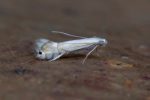
 Leaf-miner:
CAT L
– The leaf or a Photo required –
Leaf-miner:
CAT L
– The leaf or a Photo required –
 Larval Case:
C1
– Distinctive Species –
Larval Case:
C1
– Distinctive Species –
 – click for General Verification Guidelines |
– click for Specific Verification Guidelines
– click for General Verification Guidelines |
– click for Specific Verification Guidelines
 – Uncertain/Unknown – Insufficient Data
 – Leaf-miner
 – difficult to identify – detailed examination required, often a Gen Det and/or specimen and quality photographs are required.
Confusion Species: see latest information here – http://www.leafmines.co.uk/pdfs/newsletter%2045.pdf
Recent research, including DNA analysis, has revealed that what was previously identified as a single species in the UK is actually a complex of four distinct but visually similar species: P. saligna (sensu stricto), P. asiatica, P. ramulicola, and P. triandricola.
Due to this complexity, positive identification of adults usually requires the dissection of female genitalia, as males are currently indistinguishable by this method. The morphology of the larval mines is also being studied to assist with identification.
Mine Period Additional: None.
Mine ID Difficulty:
 – Mine cannot be identified without breeding through and then adult may need to be examined by Gen Det Prep.
Mine Type/s: Gallery
Mine Feeding Method/s: Leaf Fold
Mine Comment: A tortuous lower epidermal mine with a central brownish frass-line. The larva then mines into the petiole and subsequently into a second leaf, normally opposite, where it creates another similar epidermal mine. Apparently P. saligna/asiatica – ongoing work Nationally to provide some clarity on supposed food-plant separation (asicatica on crack/white/weeping willows etc, saligna only on Purple Willow?). The larva may leave one leaf via the petiole to mine the bark of a twig before entering a second leaf to continue feeding and eventually pupate in a fold at the leaf edge. See latest information here – http://www.leafmines.co.uk/pdfs/newsletter%2045.pdf


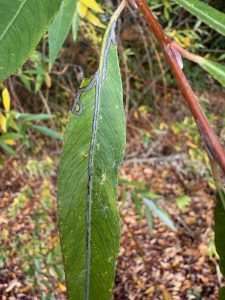
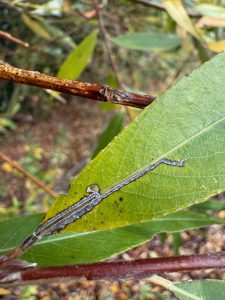


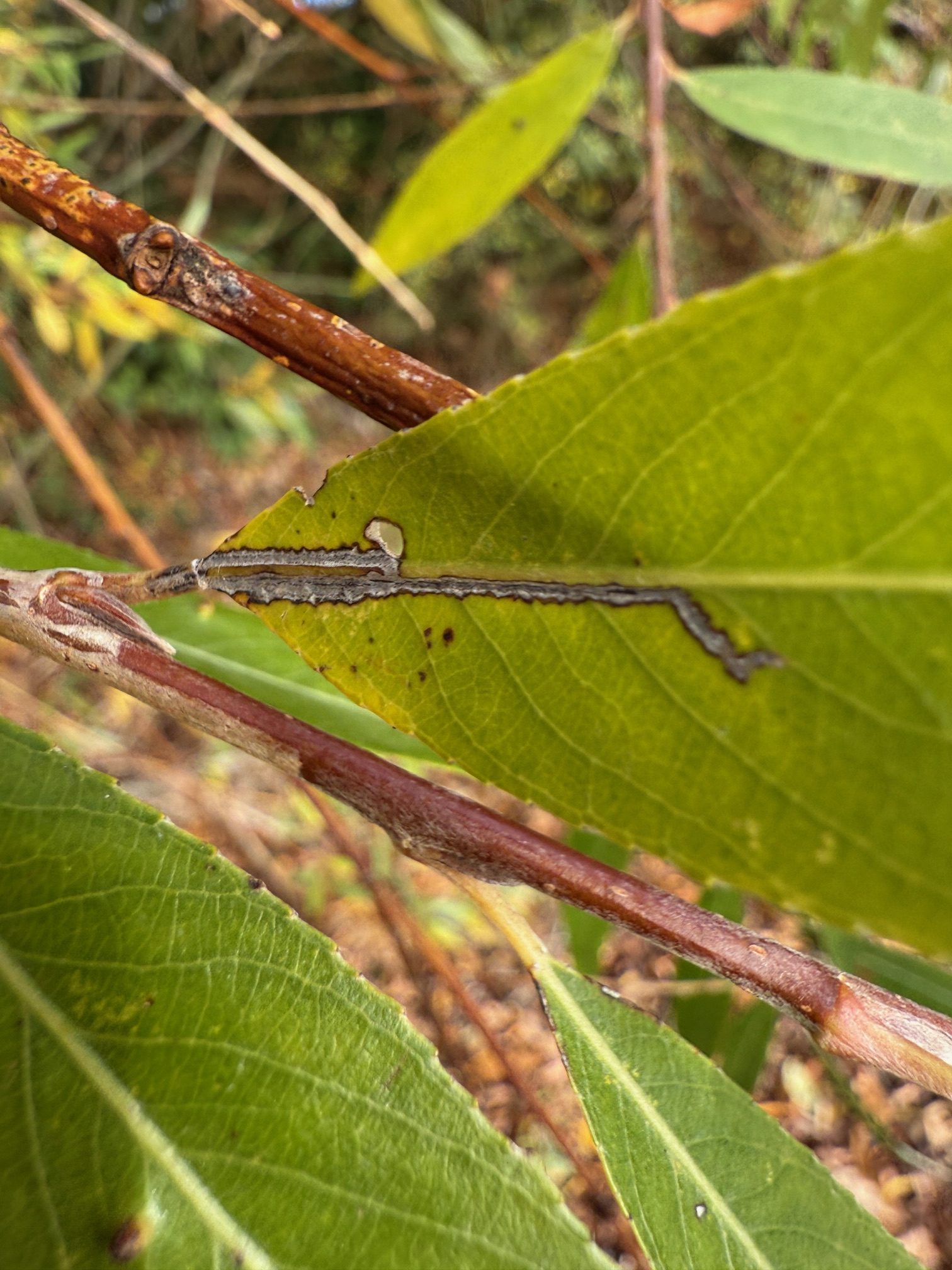
Image Gallery


Temporal Distribution Chart
Adults: (between 2018 - 2024) | Immatures: (between 2022 - 2024)
Changes in First and Last Recorded Activity Dates Over Time
Distribution Map for Phyllocnistis saligna
↳ from 2026+
↳ 7 from 2020 - 2025
↳ 2 from Before 2020
If the Map Layers function fails, just refresh the page and it should be OK after. Use the +- zoom on the top left, or on a tablet, use two fingers to zoom. Remember, the last layer you ticked is the one which displays the popup information - they sit on top of each other - de-select then re-select, to see the popup values.
Bedrock Geology ** indirectly affects moth distribution by influencing the type of habitat and food plants available in an area. In turn, this may affect the types of moths that can thrive, or where they can most likely be found.
NBN Atlas UK Distribution for – Phyllocnistis saligna
⚠️ Please wait for the map to load fully – do not click the link shown.
Note – the NBN Atlas datasets are listed in the map below and vary in their currency (uptodateness) – however,
the map does give a general indication of the moth's distribution across the UK.
Monthly Records By Year:
Phyllocnistis saligna
( data includes both Larvae and Adult Stages )
Monthly Counts By Year:
Phyllocnistis saligna
( data is based on 'Adult' stage records only )
First/Last Recorded Dates: Phyllocnistis saligna
Adult-only & Anything [Larvae, Pupae, Adult, Mines]
Shading shows moth presence between dates
Click the colour discs below to Select/De-select as Required
Recordings By Year: Phyllocnistis saligna
( All data includes both Larvae and Adult Stages )
Annual Growth Rate (AGR): Phyllocnistis saligna
AGR: 0% | Total % Change: 0%
Hectad (10kmx10km) Coverage: Phyllocnistis saligna
( data includes both Larvae and Adult Stages )
Flight Periods – Indicative –vs– Recorded Data
Phyllocnistis saligna
Phyllocnistis saligna
Flight Period chart – the grey hatched area above, which can cross one or more months, pictorially represents the best guess we have for this moth's flight periods [month/s]. The coloured lines represent the actual months seen in flight, from site observation records received between 2020-2026.
Mine Periods – Indicative –vs– Recorded Data
Phyllocnistis saligna
Phyllocnistis saligna
( data includes both Larvae and Adult Stages )
Mine Period chart – the grey hatched area above, which can cross one or more months, pictorially represents the best guess we have for this moth's mine periods [month/s]. The coloured lines represent the actual months seen mining, from site observation records received between 2020-2026.
Records Behind the Map and Charts - Phyllocnistis saligna – 9 records available
Listed by Year - descending - scroll across to see all table columns
| Site Name | Tetrad | Date | Count | Stage | Recorder | Source | RecordKey |
|---|---|---|---|---|---|---|---|
| Pottery Wood | SK32G | 05/11/2024 | 1 | Mine | Finch, Graham Leonard | vc57_irecords_extract | iBRC41038961 |
| Burton upon Trent | SK32P | 05/11/2024 | 1 | Mine | Finch, Graham Leonard | vc57_irecords_extract | iBRC41038916 |
| Staveley Derbyshire | SK47H | 30/08/2024 | 1 | Adult | Morris, Sid | vc57_irecords_extract | iBRC38410548 |
| Allestree Park | SK34K | 25/09/2022 | 1 | Mine | Finch, Graham Leonard | vc57_irecords_extract | iBRC35105372 |
| Main Street, Kings Newton | SK32Y | 14/08/2020 | 1 | Adult | Soar, Will | vc57_irecords_extract | iBRC34059841 |
| Woodland Ave | SK43R | 01/08/2020 | 1 | Adult | Thorpe, Steve | vc57_irecords_extract | iBRC33501896 |
| Woodland Ave | SK43R | 29/07/2020 | 1 | Adult | Thorpe, Steve | vc57_irecords_extract | iBRC33501797 |
| Main Street, Kings Newton | SK32Y | 18/07/2018 | 1 | Adult | Soar, Will | vc57_irecords_extract | iBRC34059842 |
| Main Street, Kings Newton | SK32Y | 17/07/2018 | 1 | Adult | Soar, Will | vc57_irecords_extract | iBRC34059843 |