

 Larval Case:
C2
– Photo or specimen of larval case/plant required –
 – click for General Verification Guidelines
|
– click for Specific Verification Guidelines
Verification Notes: Gen Det required for adults
 – Uncertain/Unknown – Insufficient Data
 – Leaf-miner
 – difficult to identify – detailed examination required, often a Gen Det and/or specimen and quality photographs are required.
Confusion Species: Like many of the coleophora species the adults are vertually impossible to identify without dissection.
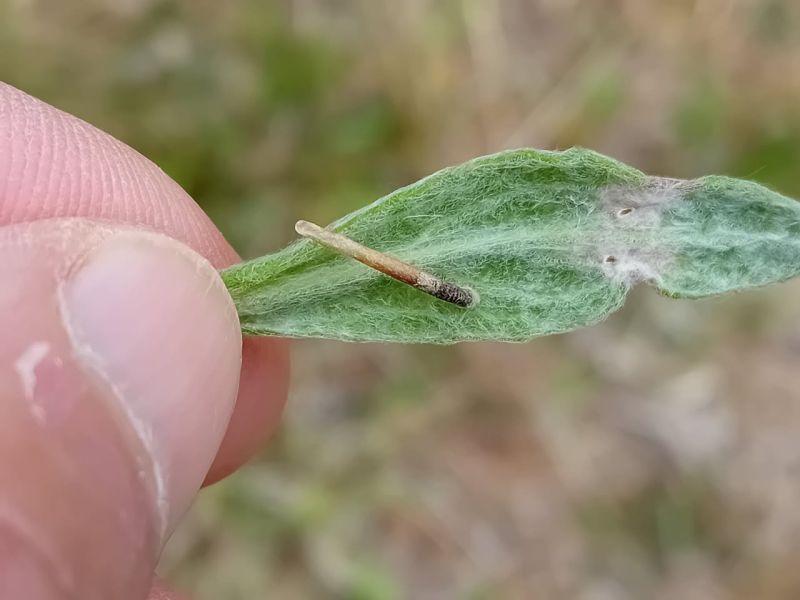
Mine Period Additional: The larvae build a so called “Pistol Case” feeding on Ploughman’s Spikenard (Inula conyzae) or Common Fleabane (Pulicaria dysenterica).
Mine ID Difficulty: Not Recorded
Mine Type/s: Not Recorded
Mine Feeding Method/s: Not Recorded
Mine Comment: The larvae mine the leaves of Ploughman’s Spikenard (Inula conyzae) and Common Fleabane (Pulicaria dysenterica), though they live inside a portable silken “pistol case” rather than staying permanently inside the leaf.


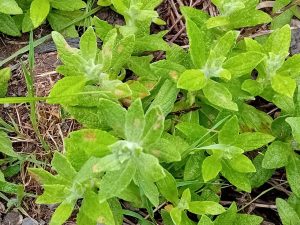


Image Gallery


Temporal Distribution Chart
Immatures: (between 2025 - 2026)
Changes in First and Last Recorded Activity Dates Over Time
This chart presents a time-series summary of recorded observations. It is based on available records at the time of analysis and will evolve as further data are added. The five-year moving average provides a smoothed representation of variation in recorded adult and immature activity over time, helping to illustrate longer-term trends in the earliest and latest recorded dates.
Annual record totals are shown for context; years with fewer records may provide a less complete representation of activity than years with higher recording intensity. Interpretation should consider that apparent trends may reflect both biological change and variation in recording effort.
Note: Clicking either the Adult Range.... or Immature Range... legends allows you to hide them, to show more discrete data.
Distribution Map for Coleophora inulae
↳ 6 from 2026+
↳ 4 from 2020 - 2025
↳ 0 from Before 2020
If the Map Layers function fails, just refresh the page and it should be OK after. Use the +- zoom on the top left, or on a tablet, use two fingers to zoom. Remember, the last layer you ticked is the one which displays the popup information - they sit on top of each other - de-select then re-select, to see the popup values.
Bedrock Geology ** indirectly affects moth distribution by influencing the type of habitat and food plants available in an area. In turn, this may affect the types of moths that can thrive, or where they can most likely be found.
NBN Atlas UK Distribution for – Coleophora inulae
⚠️ Please wait for the map to load fully – do not click the link shown.
Note – the NBN Atlas datasets are listed in the map below and vary in their currency (uptodateness) – however,
the map does give a general indication of the moth's distribution across the UK.
Monthly Records By Year:
Coleophora inulae
( data includes both Larvae and Adult Stages )
Monthly Counts By Year:
Coleophora inulae
( data is based on 'Adult' stage records only )
First/Last Recorded Dates: Coleophora inulae
Adult-only & Anything [Larvae, Pupae, Adult, Mines]
Shading shows moth presence between dates
Click the colour discs below to Select/De-select as Required
Recordings By Year: Coleophora inulae
( All data includes both Larvae and Adult Stages )
Annual Growth Rate (AGR): Coleophora inulae
AGR: 0% | Total % Change: 0%
Coleophora inulae
Insufficient records/data for an AGR analysis
Hectad (10kmx10km) Coverage: Coleophora inulae
( data includes both Larvae and Adult Stages )
Flight Periods – Indicative –vs– Recorded Data
Coleophora inulae
Coleophora inulae
Flight Period chart – the grey hatched area above, which can cross one or more months, pictorially represents the best guess we have for this moth's flight periods [month/s]. The coloured lines represent the actual months seen in flight, from site observation records received between 2020-2026.
Mine Periods – Indicative –vs– Recorded Data
Coleophora inulae
Coleophora inulae
( data includes both Larvae and Adult Stages )
Mine Period chart – the grey hatched area above, which can cross one or more months, pictorially represents the best guess we have for this moth's mine periods [month/s]. The coloured lines represent the actual months seen mining, from site observation records received between 2020-2026.
Records Behind the Map and Charts - Coleophora inulae – 10 records available
Listed by Year - descending - scroll across to see all table columns
| Site Name | Tetrad | Date | Count | Stage | Recorder | Source | RecordKey |
|---|---|---|---|---|---|---|---|
| Seymour MVN | SK47L | 08/06/2026 | 100 | larval case | Radford, Mark | vc57_irecords_extract | iBRC53243638 |
| Arkwright Pit | SK47F | 29/05/2026 | 5 | larval case | Radford, Mark | vc57_irecords_extract | iBRC52779070 |
| Hall Lane Pond | SK47H | 28/05/2026 | 5 | larval case | Radford, Mark | vc57_irecords_extract | iBRC52742844 |
| Markham Vale South Tip | SK47K | 27/05/2026 | 100 | larval case | Radford, Mark | vc57_irecords_extract | iBRC52722214 |
| Poolsbrook CP North | SK47M | 27/05/2026 | 1 | larval case | Radford, Mark | vc57_irecords_extract | iBRC52701230 |
| Seymour MVN | SK47M | 27/05/2026 | 5 | larval case | Radford, Mark | vc57_irecords_extract | iBRC52701281 |
| Former Hall Lane landfill site (Dev's) | SK47H | 23/06/2025 | 10 | larval case | Radford, Mark | vc57_irecords_extract | iBRC42573844 |
| Markham Vale complex | SK47L | 19/06/2025 | 50 | larval case | Radford, Mark | vc57_irecords_extract | iBRC42436689 |
| Foxlow Ponds | SK47I | 27/05/2025 | 3 | larval case | Radford, Mark | vc57_irecords_extract | iBRC41880565 |
| Markham Vale complex | SK47L | 26/05/2025 | 250 | larval case | Radford, Mark | vc57_irecords_extract | iBRC41826206 |